

Your VA loan is one of the most valuable benefits of your service, but it doesn’t have to stay the same for the life of your mortgage. As interest rates and your budgets and goals shift, refinancing gives you the chance to make your loan work better for you. Veterans have two main VA-backed options: the VA IRRRL and the VA Cash-Out Refinance. Knowing the difference can help you decide which financing product fits your needs.
Why Veterans May Want to Refinance Their VA Loan
Before we explore your VA loan refinancing options, let’s look at some of the most common reasons veterans and service members choose to refinance. These can help you decide whether a Streamline or Cash-Out refinance is the right fit for you.
Lower Monthly Payments

Refinancing to a lower interest rate can reduce your monthly obligation and ease your budget.
Switch From Adjustable to Fixed Rate
Moving from an ARM to a fixed-rate loan brings stability and peace of mind by keeping payments predictable.
Access Cash From Home Equity
A cash-out refinance lets you tap into your home equity for renovations, education or debt consolidation.
Shorten the Loan Term
Refinancing into a shorter term can help you pay off your mortgage sooner and build equity faster.
Change From Non-VA Loan
Some veterans use a VA refinance to roll a conventional, FHA or USDA loan into a VA-backed loan with potentially better terms.
Two Refinance Paths: Streamline (IRRRL) vs. Cash-Out
As mentioned before, the two main VA-backed refinance options are the Streamline Refinance, officially called the Interest Rate Reduction Refinance Loan (IRRRL), and the Cash-Out Refinance. Which one is right for you depends on whether you’re focused on saving money or accessing cash.
Streamline (IRRRL) Refinance
The VA Interest Rate Reduction Refinance Loan—often called the VA Streamline Refinance or IRRRL—is designed to make it easier for current VA borrowers to lower their monthly payment or secure a more stable loan. It replaces your existing VA loan with a new one, typically at a lower interest rate or with a fixed rate if you’re moving out of an adjustable-rate mortgage.
Benefits Of An IRRRL
- Lower your interest rate: The primary goal of an IRRRL is to reduce your rate and monthly payment.
- Switch from ARM to fixed: An IRRRL allows you to transition from an adjustable-rate mortgage to a fixed-rate loan for more stable monthly payments.
- Little or no out-of-pocket costs: Many borrowers can roll closing costs into the new loan, which means you may not need to bring cash to the table if you are qualified. You may still be required to pay taxes, insurance and pre-paid interest.
- No appraisal required: Unlike other refinance options, you generally won’t need a new appraisal, saving time and expense.
- Flexible eligibility: The VA makes qualifying easier. Often, no income or credit documentation is required.
- Option to shorten your term: You may be able to move from a 30-year to a 15-year loan to pay off your mortgage sooner, sometimes without a big jump in monthly payments.
What to Consider With an IRRRL
- No cash back: This refinance is strictly for lowering your interest rate or switching to a fixed-rate. If you need funds from your home’s equity, you’ll want to look at a VA Cash-Out Refinance instead.
- Must already have a VA loan: The IRRRL is only available to borrowers with an existing VA-backed mortgage.
- Funding fee: Most borrowers pay a 0.5% VA funding fee, though it can be rolled into the loan. Veterans with service-connected disabilities are exempt.
- Long-term costs: Even with a lower monthly payment, extending your loan term may increase your total finance charges over the life of the loan.
- Must be your primary residence: The home you are refinancing must still be your primary residence. Eligible property types includes single-family homes, properties with up to four units, condominiums and manufactured homes.
Best Fit For
A VA Streamline Refinance is best for qualified borrowers who already have a VA loan. It offers a faster, lower-cost way to reduce payments or lock in a fixed rate without the extra steps of a traditional refinance.
VA Cash-Out Refinance
The VA Cash-Out Refinance gives qualified veterans the opportunity to tap into their home equity while replacing their current mortgage—whether VA or non-VA—with a new VA-backed loan. Unlike a traditional home equity loan or HELOC, it is a full refinance, meaning you’ll have one new loan with predictable fixed-rate payments.
Benefits Of A VA Cash-Out Refinance
- Access your home’s equity: Borrow against your home’s value to fund renovations, consolidate high-interest debt or handle major expenses, like tuition.
- Finance up to 100% of your home’s value: In many cases, you can refinance up to the full appraised value of your property.
- Roll in closing costs: Just like an IRRRL, closing costs can often be financed into the loan, reducing upfront expenses.
- Convert to a VA loan: Even if your current mortgage is FHA, USDA or conventional, you may be able to refinance into a VA-backed loan with better terms.
- Potential tax advantages: Unlike credit card interest, mortgage interest may be tax-deductible. Consult a tax advisor for details on deductibility.
Things to Consider With a VA Cash-Out Refinance
- Appraisal and underwriting required: The loan process includes a credit review and home appraisal, which makes it longer than an IRRRL.
- Closing costs and VA funding fee: These fees are higher than a streamline refinance and you will need to pay a VA funding fee (unless exempt).
- Bigger loan balance: Taking cash out increases your loan amount, which can mean higher long-term interest costs if not managed carefully.
Best Fit For
A VA Cash-Out Refinance is best for eligible veterans who want to use their home equity to cover major expenses, consolidate debt at a lower interest rate or refinance a non-VA loan into a VA-backed mortgage.
Comparing VA IRRRL vs. VA Cash-Out Refinance
Not sure which VA refinance might work for you? This chart makes it easy to compare an IRRRL with a Cash-Out at a glance.
| VA IRRRL (Streamline Refinance) | VA Cash-Out Refinance | |
| Best for | Lowering your rate or moving from ARM to fixed | Getting cash from your home’s equity or switching a non-VA loan to VA |
| Cash-out option | No | Yes |
| Appraisal | Usually not required | Required |
| Paperwork | Minimal | Full underwriting |
| Funding fee | Lower (about 0.5% if not exempt) but can be rolled into loan | Higher (2.3%–3.6% if not exempt) but can be rolled into loan |
| Timeline | Quicker process | Takes more time |
When Should You Refinance?
Refinancing is about making your mortgage work better for you. The optimal timing can help you save money, lock in peace of mind with steady payments or even give you access to cash when life calls for it. Here are a few times when refinancing may be worth a closer look:
- Rates drop significantly below your current rate
- You want to move from an ARM to a fixed rate for stability
- You need funds for home improvements, debt consolidation or other big expenses
- You plan to stay in your home long enough to make back your closing costs
A good rule of thumb is to calculate your break-even point. Your break-even point is how long it takes for the money you save from refinancing to add up to the amount you paid in closing costs. Once you pass that point, the refinance is saving you money.
Steps to Refinance Your VA Loan
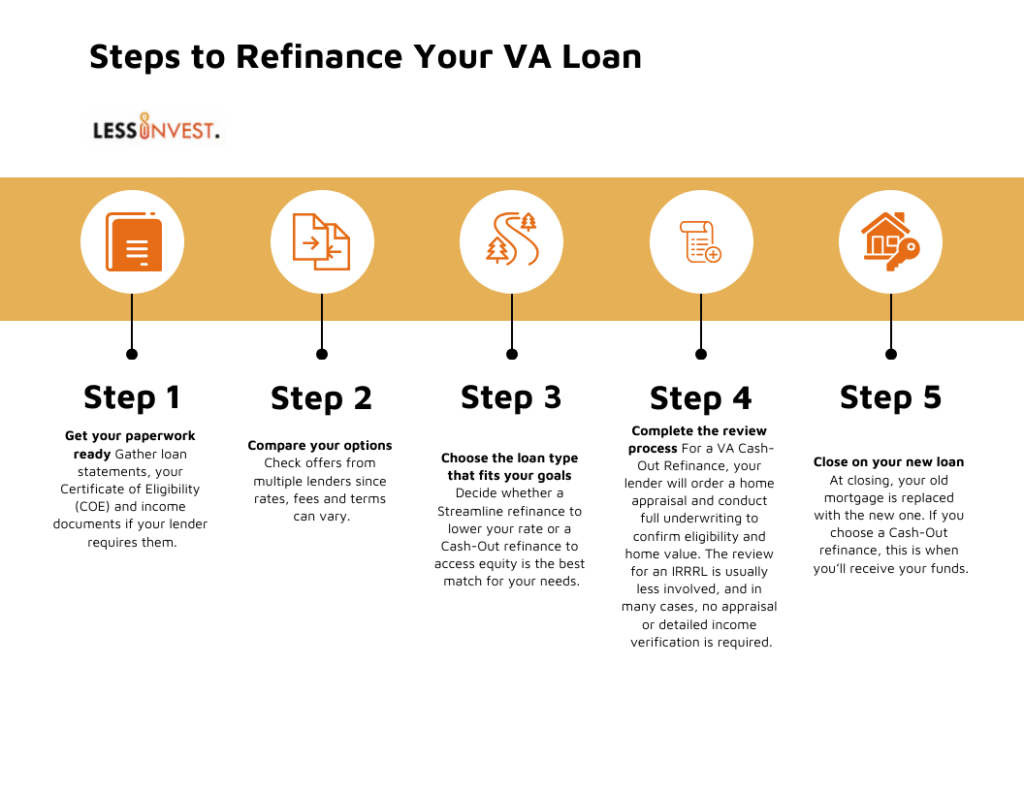
Once you’ve decided to refinance your VA loan, the exact process will depend on your lender and whether you choose a Streamline or Cash-Out option. In most cases, it involves the following steps:
Step 1: Get your paperwork ready
Gather loan statements, your Certificate of Eligibility (COE) and income documents if your lender requires them.
Step 2: Compare your options
Check offers from multiple lenders since rates, fees and terms can vary.
Step 3: Choose the loan type that fits your goals
Decide whether a Streamline refinance to lower your rate or a Cash-Out refinance to access equity is the best match for your needs.
Step 4: Complete the review process
For a VA Cash-Out Refinance, your lender will order a home appraisal and conduct full underwriting to confirm eligibility and home value. The review for an IRRRL is usually less involved, and in many cases, no appraisal or detailed income verification is required.
Step 5: Close on your new loan
At closing, your old mortgage is replaced with the new one. If you choose a Cash-Out refinance, this is when you’ll receive your funds.
What to Keep In Mind
While refinancing can help you reach your goals, it’s important to be aware of a few requirements. Keeping these in mind will help you approach the process with confidence:
VA Funding Fees
Both refinance types include a VA funding fee, though it’s usually lower for IRRRLs (about 0.5%) compared to a VA Cash-Out loan.
Net Tangible Benefit
The VA requires that an IRRRL provide a clear Net Tangible Benefit, such as lowering your payment or moving to a fixed rate. For Cash-Out refinances, the VA instead requires full underwriting and appraisal to ensure the loan is affordable and properly supported by your home’s value.
Loan Seasoning
The VA requires a minimum waiting period before any refinance—whether IRRRL or Cash-Out—can close. You must have made at least six consecutive monthly payments on your current loan, and at least 210 days must have passed since your first payment.
Use Your VA Benefits to Refinance Your Loan
You served. You earned this. And VA refinancing gives you the chance to shape your mortgage around your needs. With options like the Streamline (IRRRL) to lower payments or the Cash-Out Refinance to access equity, you can choose the solution that best supports your goals.
